— This upcoming video may not be available to view yet.
“Ex astris scientia” is a Latin phrase meaning “knowledge from the stars” and is the slogan for Starfleet Academy, in Star Trek.
It is also the name of what is probably the best Star Trek fan site there is. And honestly, “fan site” does not really do it justice.
Ex Astris Scientia is Bernd Schneider’s Star Trek reference site. It has been running since 1998, which means it’s also probably one of the oldest Trek sites still actively maintained.
A detailed timeline of Star Trek across all the series.
But the sort of content that I find more interesting, and what made it first stand out for me, is a bit weirder.
For example, in Star Trek The Next Generation, captain Picard often had a book of Shakespeare open in his ready room. Did you know that the page it was opened on was usually different?
— This upcoming video may not be available to view yet.
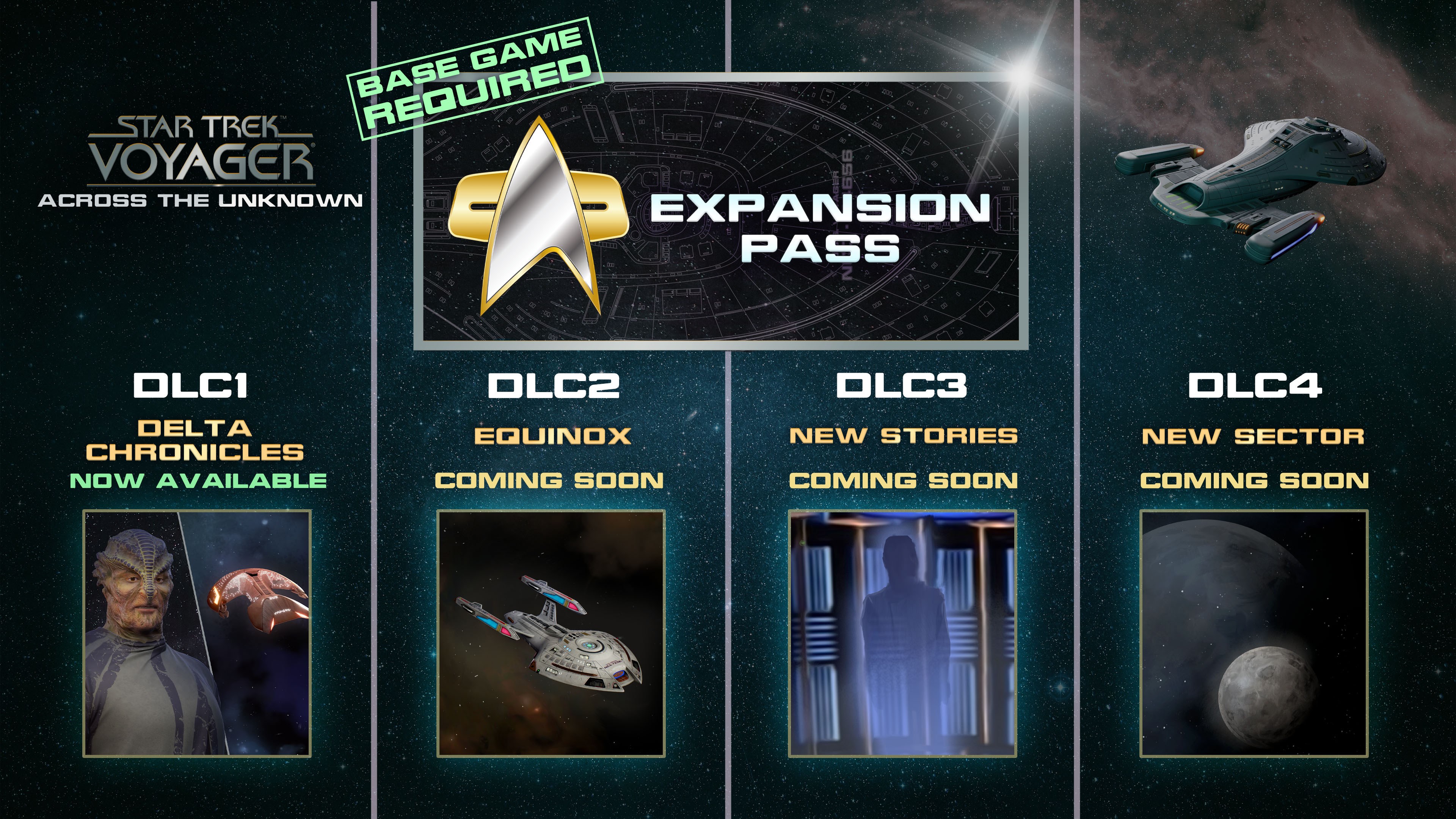
Daedalic Entertainment and Gamexcite have announced downloadable content for Star Trek: Voyager - Across the Unknown, including some that is already out now.
In my earlier post about the base game, I noted a few things I’d like to see in a DLC. Very little detail has been confirmed and I don’t really expect much of the specifics of my suggestions to make it.
However, one thing has been confirmed: a mode featuring the U.S.S. Equinox. And honestly I’m happy to see any extra support.
The first DLC is available now with the rest coming throughout the year. Hopefully if it is successful, there will be more.
DLC 1: Delta Chronicles – available now.
New missions, recruitable heroes, six new technologies and four NPC ships.
DLC 2: U.S.S. Equinox - soon
Contains a completely new, playable ship along with crew, technology and more.
DLC 3: later this year
Contains more missions, heroes, technologies and NPC ships.
DLC 4: New sector - later this year
Contains a whole new sector with storyline, missions, characters, NPC ships and technologies.
— This upcoming video may not be available to view yet.
I recently bought Star Trek: Voyager - Across the Unknown, a story-driven survival strategy game developed by Gamexcite and published by Daedalic Entertainment.
In fact, I pre-ordered it. Pre-ordering is something I tend to reserve for things I feel the need to signal support for that might otherwise struggle. I was a big fan of Star Trek in the 90s and early 2000s, and while recent Star Trek has been more of a mixed bag for me, I was excited for a new game based on this era, even if some of that is nostalgia.
It is surprising that anyone would base a game on a TV show that last aired nearly 25 years ago, and probably a bit of a gamble. That said, the last Star Trek: Voyager game I played was Elite Force, which was projected to sell 700,000 units but reportedly only sold around 300,000 worldwide which was considered an underperformance. Across the Unknown has already sold 100,000 units; whether that meets its presumably more modest target I can’t say, but it at least suggests I’m not alone in my nostalgia for this era of Star Trek.
Spoiler warning: The rest of this post contains spoilers for the game (and, in case it matters, Star Trek: Voyager).
Gameplay summary
The game is strongly structured around the major events of the show like the Kazon, the Borg, the Hirogen, the Borg again, which you encounter in order. These can’t be avoided, but how you handle them is up to you. Smaller, less significant events from the show are scattered throughout as optional encounters that you have to seek out.
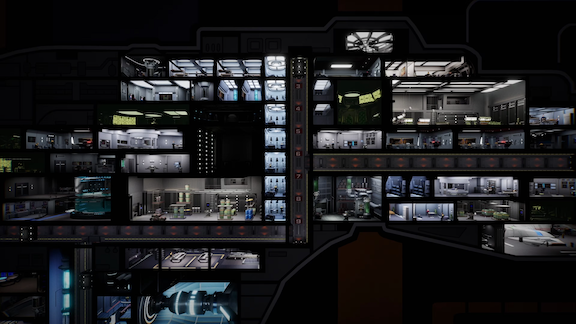
In terms of feel, it’s a bit like Fallout Shelter (I mean the ship overview even looks like Fallout Shelter). Resource management is the foundation, with the most significant resource being morale. If it gets too low crew will mutiny. You make the decisions, whether to be diplomatic or aggressive, whether to embrace dangerous technologies like Borg research, and the game features roguelike elements, so each run plays out differently, with crew members permanently lost if things go wrong.
Advice to new players: If you leave a sector while someone is off the ship, they will be gone forever. The game technically warns you of this but is a bit understated, and sometimes you may have even missed that someone was off the ship. In my current run I guess I’ll never know what happened to Tom.
The game also covers ship management (repairing and constructing rooms, managing energy and life support), exploration, away missions, and ship-to-ship combat. The combat is a bit basic, but to be honest I think that fits in with the way combat has always worked in the show. In fact it is interesting how much Star Trek games have focused on robust combat mechanics when it was never really like that on-screen.
My thoughts
The introductory mission with the Caretaker is a bit long and a little annoying to play more than once, though you can influence things - including ending the game early by simply using the Caretaker’s array to go home.
Initially it feels like you follow the show’s story very closely, which can feel restrictive. But there is more flexibility than it first appears. You can recruit Seska, recruit a Kazon, lose Chakotay, and end up with zero, one, or more of human Torres, Klingon Torres, and “real” Torres. And of course you get to choose what happens to Tuvix.
The dialogue is not amazing, but somehow quaint. There is generally no voiceover except for the sector introductions by Tim Russ and Robert Duncan McNeill.
The game is hard. There are three difficulties - “Adventure”, “Survival”, and “Years of Hell”. I initially tried “Survival”. I thought it was quite easy and things were going well, until everything fell apart. I’ve since dropped to “Adventure” and I’d recommend it as a first playthrough since it is the best for exploring “what if?” scenarios.
Should you buy it
If you are a fan of Star Trek: Voyager, absolutely. If you are a fan of Star Trek of this era and want more video games based on it, then also absolutely. If you are a fan of Star Trek in general and are at least moderately interested in roguelikes or resource management games, then probably. Otherwise, it’s harder to say. On its own merits, without being based on Star Trek: Voyager, I’m not sure how well it stands up.
If you are a fan of the show, some of the elements are strongly telegraphed. For example, while fighting the Kazon you find out there is a traitor on the ship. If you watched the show you know who it is, and that can’t be changed. You can influence what happens, but you already know who to trust. This continues throughout the game, and many of the optional side missions are even named after the relevant episodes so you can see what is coming. It’s an interesting choice. Part of me wants to see what a playthrough by someone who hasn’t seen every episode several times would look like.
Suggestions for improvements
It would be nice if the player could control the ship right from the start while trying to find Chakotay and the Maquis. Some mechanics could remain locked, but it could be a good way to tease the player with what they can achieve by briefly showing them a fully functioning Voyager.
The away team mechanics are pretty cool but there aren’t enough missions. It would be good to see more of them, and perhaps with a bit more secrecy - currently you can see all the required specialties before starting a mission, which makes things a little too gameable. There’s also an opportunity to introduce random events during missions. The Star Trek CCG is structured around missions and dilemmas, where dilemmas represent generic1 things that could go wrong on a mission that the crew have to deal with. Something like that could work well here. Similarly, most space locations are just random resource gathering, and it would be interesting to see some kind of minigame introduced there too.
More randomness in general would be welcome. My ideal would be the ability to choose how closely the story matches the show when starting a run: what if Seska isn’t the traitor, or the crew encounter the Hirogen before the Kazon, or some entirely original events are introduced? On a similar note, playing with different ships could be interesting. Some suggestions I’ve seen are a harder mode based on the U.S.S. Equinox or Defiant-class, or an easier mode in a Galaxy-class ship. Probably beyond scope for a DLC, but someone suggested a version based on navigating the Delphic Expanse from season 3 of Enterprise, which I’d happily play.
Okay, most of them aren’t generic and some care would be needed to not introduce some absurdity. Finding out the universe only has seventy trillion years left and working out what you should do about it, while trying to retake Voyager from the Kazon, would be weird. ↩︎
Who has the privilege of being named in an episode title? Again, there are surprising edge cases so I’ve split it up into several groups.
Q appears in the most titles.
Two titles mention two characters: Datalore and Ménage à Troi (which I assumed, in the spirit of the episode, is a reference to both Deanna Troi and Lwaxana Troi).
Direct character references
Definite direct references to characters in Star Trek.
Character names that are not intended to be references to Star Trek characters. Mainly The Doctor from Voyager, but also Q2 which was the script name for the member of the Q Continuum in the TNG episode Deja Q.
Several episode titles contain a hyphen. One episode contains two. The producers and/or writers probably intended an em dash or similar but were likely limited to hyphens for technical reasons.
— This upcoming video may not be available to view yet.
Star Trek Picard season three has just completed. It was not perfect but was probably the best live action Star Trek since Enterprise.
In honor of this, here is a quick analysis of the episode titles.
I’m not including Picard in the main analysis for consistency for now. There is also a small chance there may be more episodes (or possibly something else #StarTrekLegacy).
Title length
Picard does not challenge for overall shortest or longest title.
The overall single word title stats are very similar to Enterprise.
Series
Enterprise
Picard
Total
42
13
Percentage
44.68 %
44.83 %
Shortest
2
3
Longest
12
12
Average
7.79
8
See comparison with other series'
Series
TOS
TAS
TNG
DS9
VOY
ENT
PIC
Total
5
3
50
42
77
42
13
Percentage
6.33 %
13.64 %
29.76 %
24.71 %
48.13 %
44.68 %
44.83 %
Shortest
4
3
4
3
2
2
3
Longest
13
10
16
12
14
12
12
Average
7.6
7.33
7.92
8.1
7.81
7.79
8
When split by season there is a lot variation though. I expect this to be true of most Star Trek series after Enterprise - the seasons are generally shorter and the serial nature means there are more likely to be patterns within seasons that don’t hold between them.
— This upcoming video may not be available to view yet.
With nearly 700 episodes, there were bound to be some that are similar to each other. But which are most similar? And what do we mean by similar?
Summary
Before I go into the more technical analysis, I shall begin with some headlines.
Not technically part of this analysis but there are two Star Trek movies that share a title with an episode (if you ignore the “Star Trek” part of the title):
— This upcoming video may not be available to view yet.
My earlier post included a list of all single-word episode titles. That list is long enough that it could be analyzed in isolation and still produce some interesting results. Firstly, here is a summary:
Series
TOS
TAS
TNG
DS9
VOY
ENT
Total
5
3
49
42
77
42
Percentage
6.33 %
13.64 %
29.17 %
24.71 %
48.13 %
44.68 %
Shortest
4
3
4
3
2
2
Longest
13
10
16
12
14
12
Average
7.6
7.33
7.96
8.1
7.81
7.79
Single-word titles by Series
It seems the number of single-word episode titles started low and increased over time, peaking with Voyager (although Enterprise was very close behind by percentage of total episodes).
The Original Series
The original Star Trek is the only series to have a season with no single-word titles at all (and it has two if you follow the convention that the original pilot, “The Cage” is part of its own “Season 0”).
Many titles from the original series were intentionally unusual, in the hope it would generate interest from people browsing TV listings (as explained more by Bruce Bennett). This generally led to longer titles and is part of the reason there are so few with just one word.
TNG was clearly a transition point in the history of Star Trek. It was obviously more modern and naturally led into the later series with most of the new production staff staying with Star Trek.
It was also still led by Gene Roddenberry early on, along with some of the original writers. This meant that although there were a plenty of long and unusual titles, the preference for simpler ones was becoming established.
Looking at the list of titles we can see TNG has the first that might stretch the definition of “single word”, and that maybe 11001001 is not even be a word. By my established definition though, it counts.
By the time Voyager was written, the preference for single-word titles is well established, peaking in season 2 in which 20 out of 26 have only one word, and includes two separate runs of seven consecutive episodes with single-word titles.
There is another Q pun with Q2 and a bit of controversy with 11:59.
Enterprise titles continue the trend set in Voyager, despite dipping slightly.
If you wanted to be picky you might question the single-word status of Kir’Shara since not only does it contain an apsotrophe, but also a capital letter in the middle.
My anlysis has so far treated a leading “the” as a word. Repeating this while ignoring “the” may produce interesting results, and at the very least will increase the count in Voyager season 2.
Ions
Finally, while browsing the list one interesting pattern stood out. There are 8 episode titles ending in “ions”, including the longest Transfigurations, and a further 22 ending in “ion”.
— This upcoming video may not be available to view yet.
Existing work
Firstly, after doing this much work, I have discovered someone already has done a similar investigation: How long is a Star Trek title? by Bruce Bennett, so check that out. One thing it does have that I don’t, is charts.
Improving workflow
The analysis so far has been done using a Google Docs spreadsheet. I then manually wrote the Markdown for the blog posts, which involved some tedious and error prone tables.
I was originally not going to include the giant list of every single-word episode title, since creating that table did not look like fun.
But… I also started working a little program to do more sophisticated processing, and realised I could also make the program generate the Markdown for me.
The program is a .NET 7 console application writen in C#, and writing it was probably quicker than the manipulation I had to do with the spreadsheet in the first place. It was definitely quicker than producing the Markdown tables in the first post manually.
The end result is I can generate tables of all sorts of random episode lists with different properties of varying levels of interest with very little effort.
— This upcoming video may not be available to view yet.
After starting my previous post with this question but not answering it, I’ll get straight to the point. There is a tie for first place, with two episode titles that are two characters long:
Unlike with the shortest episode title, I had a good idea what the longest one was. At least, I had two candidates, but without sitting down and counting, picking one would have been a guess. I can confirm they are the longest two, and I present them both since they are such outliers compared to the rest.
This brings us our first controversial result. I decided that ellipses should be treated as a single letter (if only for a sense of typographical superiority). In this case, treating it as three letters would produce a different result:
The titles so far have been longest by letter-count. Longest by word-count can also be determined. This gives identical results, except Voyager and the Animated Series now have ties: