Games

Q War - Shockwave game

Oliver Brown
— This upcoming video may not be available to view yet.

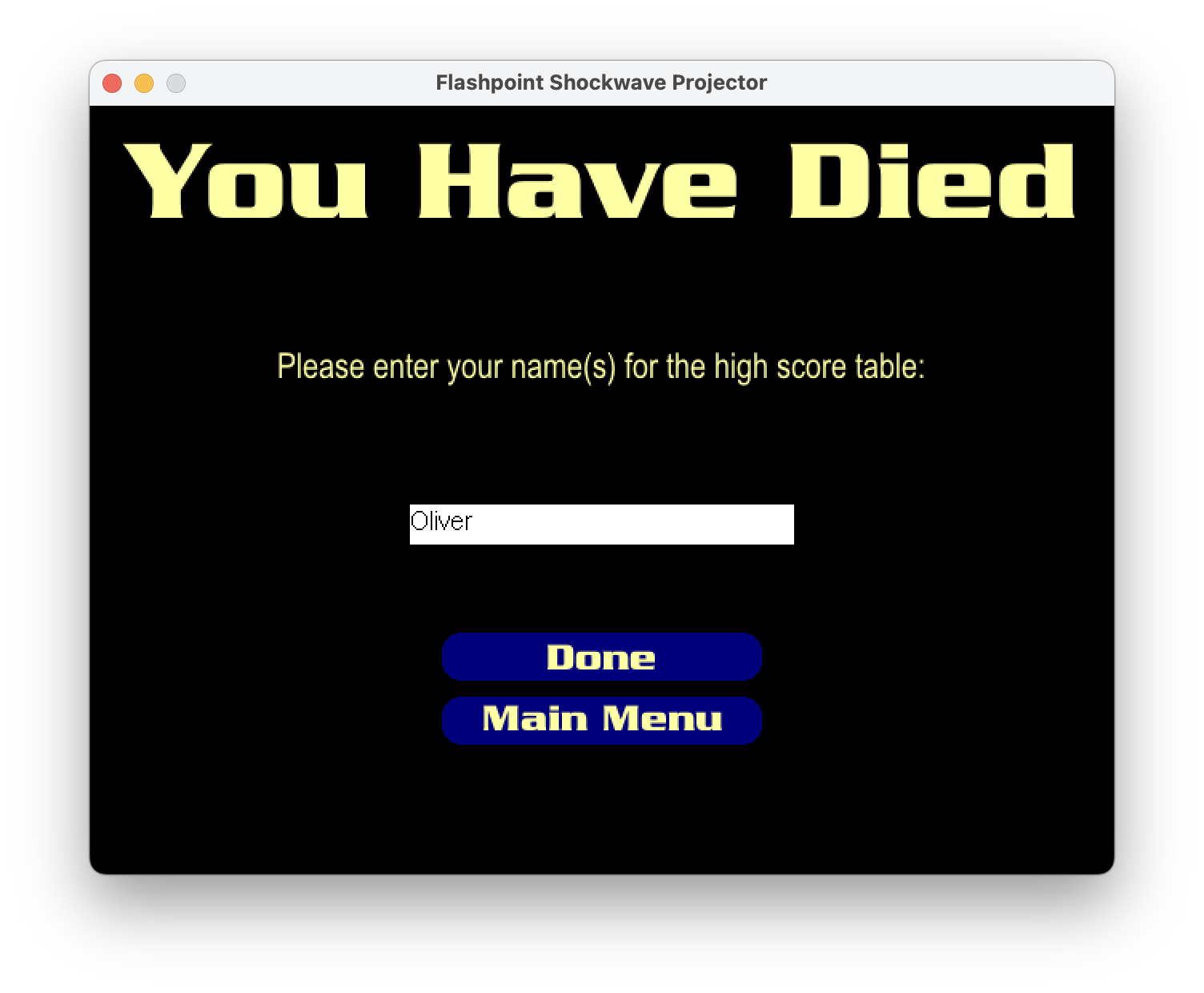
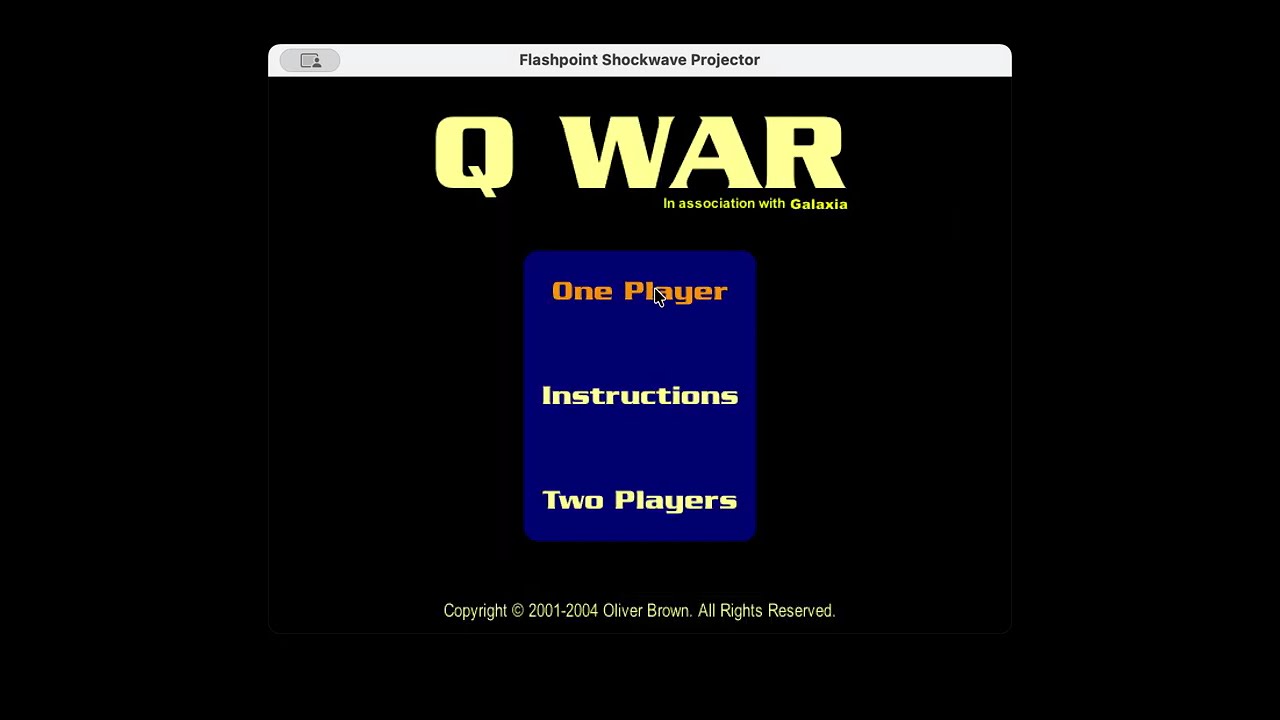
At around the same time that I worked on Supremacy, I worked on another game called “Q War”.
Interacting with this video is done so under the Terms of Service of YouTube
View this video directly on YouTube

Both were inspired by the content of Gary Rosenzweig’s Advanced Lingo for Games book. But where Supremacy was a slight refinement and rebranding of a complete game, Q War takes one behaviour (the implementation of the bullet sprites from both the “Space Invaders” and “Space Rocks” games) and builds a different game, complete with “original” graphics.

I believe I worked on Supremacy first as a learning exercise, and then started Q War. But I made Q War available first. The only hard evidence I have is the remains of the Shocklive! site in 2001:

  • 8th February - Site created! Q War, a two level action shooter is playable
  • 18th February - A Completely re-done Q War has been uploaded!
  • 14th March - Supremacy, a new fun strategy game is now available!

The game has been submitted to the Flashpoint Archive but as of 27 May it is not yet available. It is also sort of playable directly on this site.

Gameplay

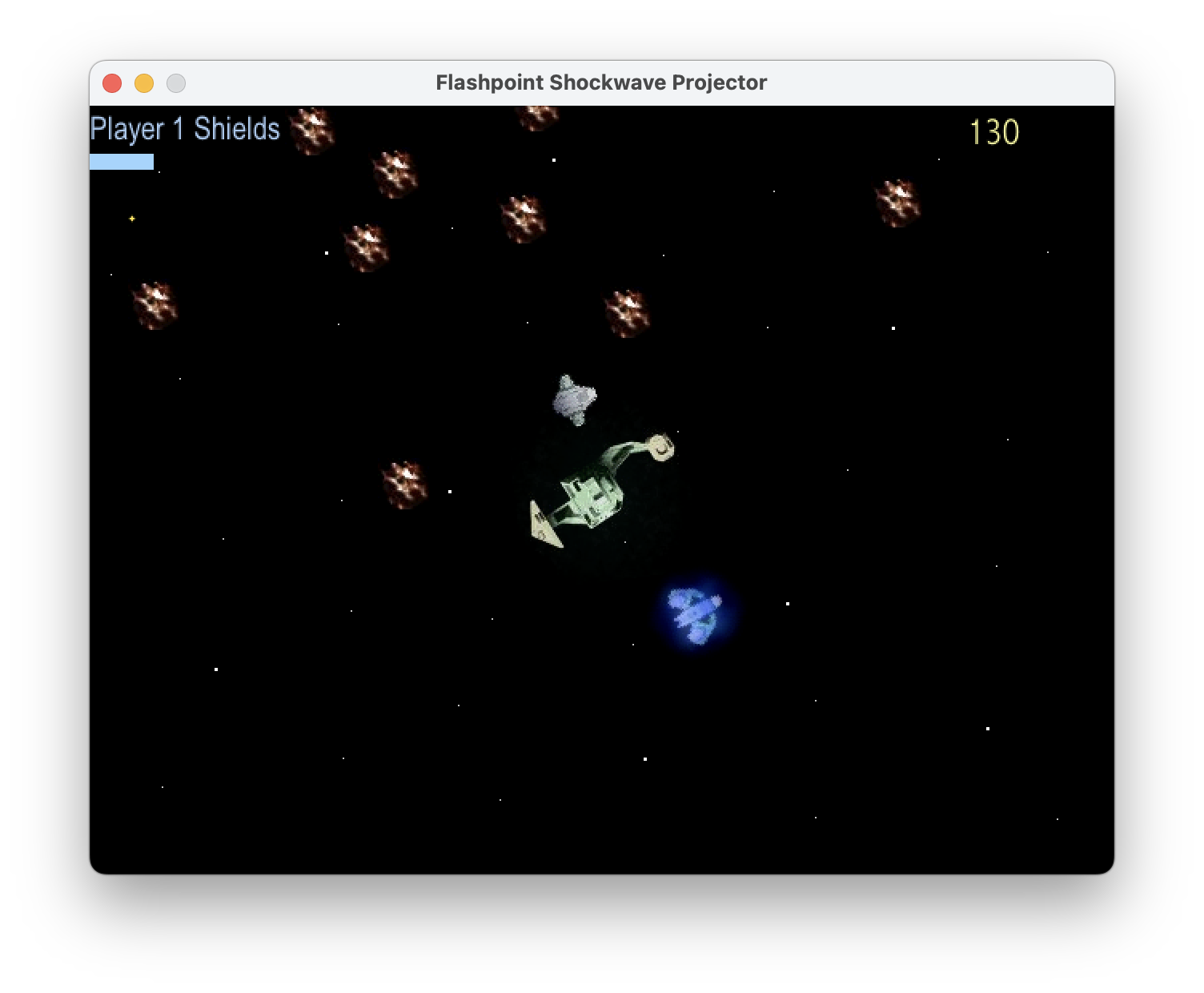
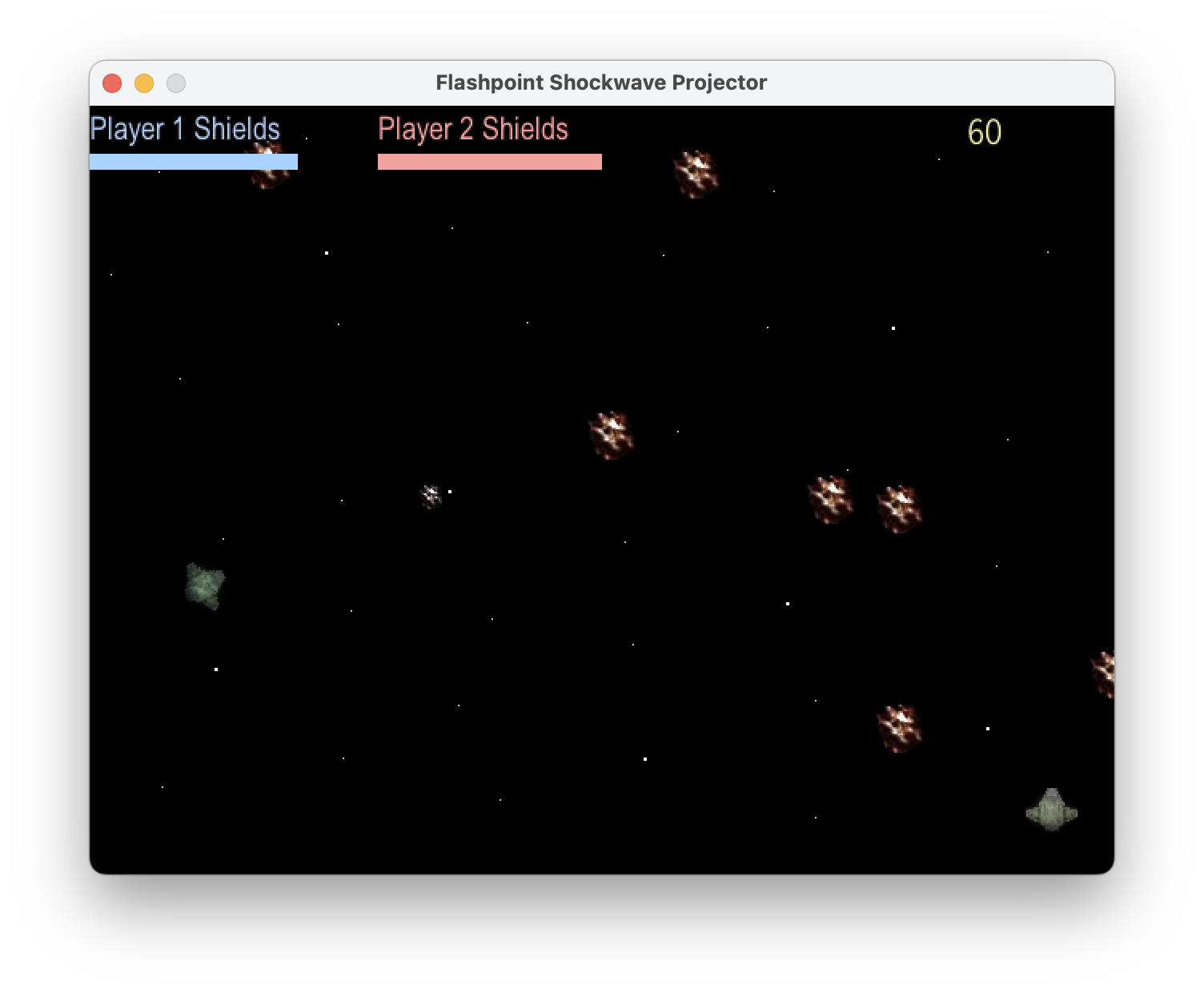
Each level puts you in control of a ship that can fly around and shoot, with limited shields that deplete as you take fire. The game supports one or two players working cooperatively.

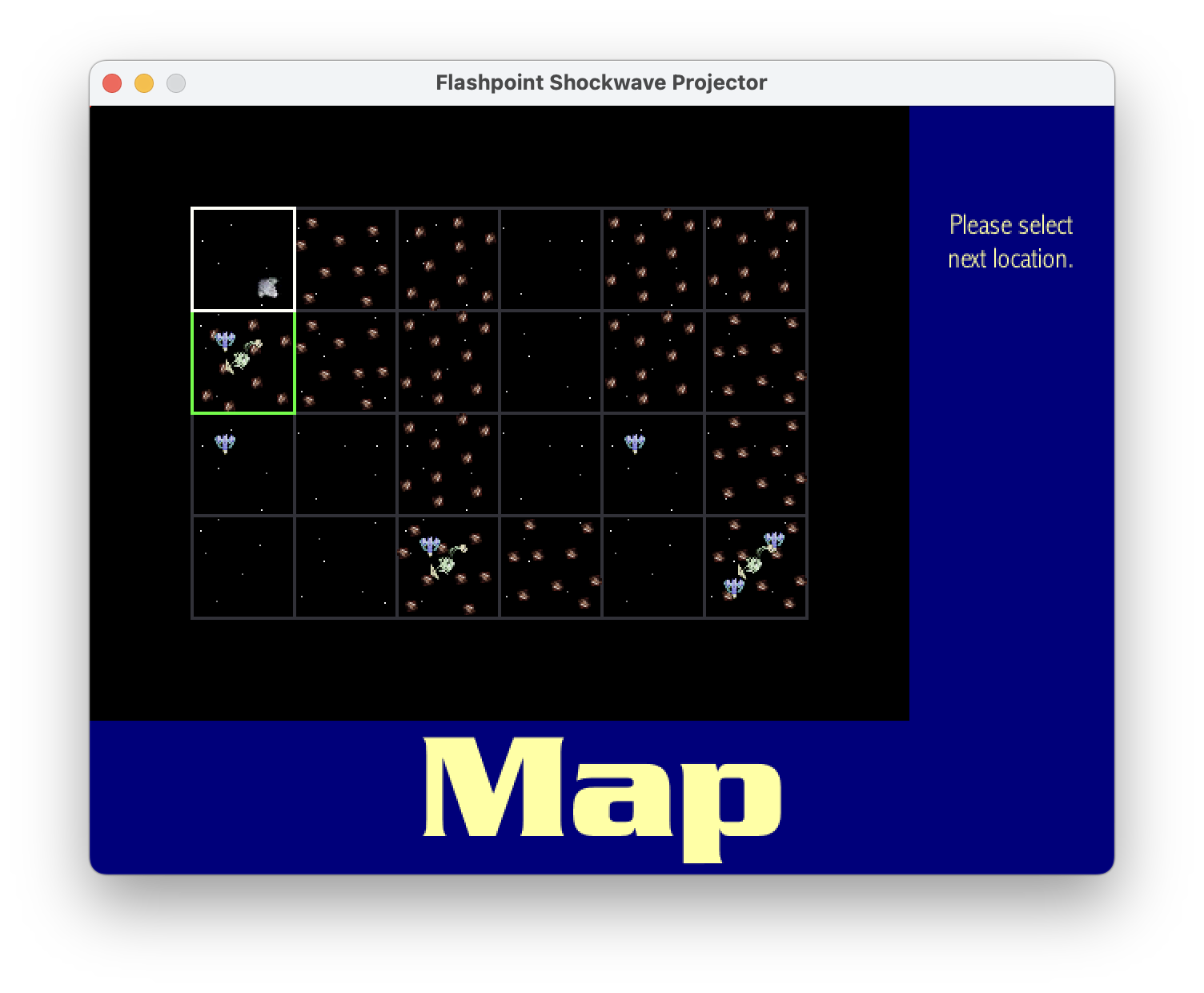
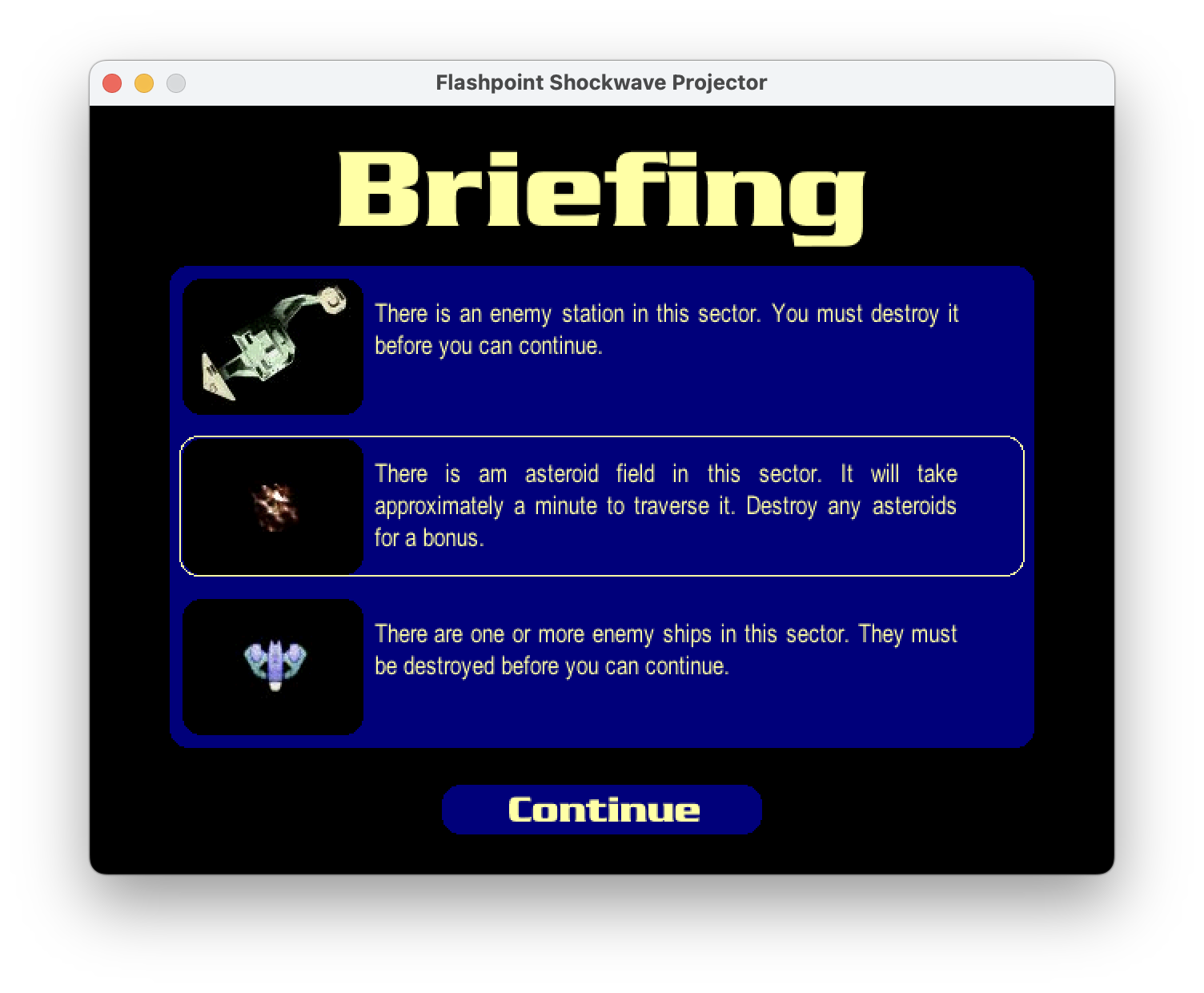
The game is split into multiple levels, connected by a map screen between each one where you choose your next destination. Starting in the top left, the goal is to reach the bottom right. Levels can be blank, or they can contain obstacles — either an asteroid belt you need to survive for a set time, a powerful enemy station that is shooting at you, or a pair of enemy ships to defeat. Any combination of those can appear in a single level, including all three at once.

Online features

Q War features two online features.

Maps

The map is loaded from the map.txt file along side the game file on the server. An example map.txt file:

[["xxx","a1x","a1x","xxx","xs1","xxx"],
 ["axx","axx","axx","asx","x2x","xxx"],
 ["axx","xxx","xxx","axx","x1x","xxx"],
 ["axx","axx","xxx","xxx","x1x","xs2"]]

Firstly, that format is the default way Lingo serialised an object. That is an array of four elements, each of which is an array of six strings.

I think the game technically predates JSON (Wikipedia says it was first specified in March 2001). It certainly predates JSON being widely used for anything. As such, Director and Lingo do not support JSON and instead use their own format. However, for string arrays, the syntax just happens to be the same.

Each string controls one map cell with the following rules:

  • If it contains an “a”, the level contains asteroids.
  • If it contains an “s”, the level contains a station.
  • If it contains a “1” the level contains one enemy ship.
  • If it contains a “2” the level contains two enemy ships.

It seems the order does not matter.

The map is also absolutely required to be exactly 6×4. It just uses direct indexing and would crash otherwise (I think technically it could be bigger without a problem).

The reason the map is loaded from a file is so I could provide multiple maps. In fact, I had it so the maps were generated by a PHP script:

Complete map script
function createMap() {
    mt_srand(time()^2);

    $rand = mt_rand(1,4);

    if ($rand <= 1) {
        $a = array('x','a','a','x','x','x');
        $b = array('a','a','a','a','x','x');
        $c = array('a','x','x','a','x','x');
        $d = array('a','a','x','x','x','x');
    } elseif ($rand <=2 ) {
        $a = array('x','a','x','x','x','x');
        $b = array('a','a','a','a','a','x');
        $c = array('x','x','a','a','a','a');
        $d = array('x','x','x','x','a','a');
    } elseif ($rand <=3 ) {
        $a = array('x','a','a','x','a','a');
        $b = array('a','a','a','x','a','a');
        $c = array('x','x','a','x','x','a');
        $d = array('x','x','a','a','x','a');
    } elseif ($rand <=4 ) {
        $a = array('x','x','a','a','a','a');
        $b = array('a','x','x','x','a','a');
        $c = array('a','a','a','x','x','x');
        $d = array('a','a','a','a','x','x');
    }

    $file = fopen('map.txt', 'w');
    fwrite($file, '[');

    for ($j=0;$j<4;$j++) {
        fwrite($file, '[');
        for ($i=0;$i<6;$i++) {
            if ($j == 0) {
                $row[$i] = $a[$i];
            } elseif ($j == 1) {
                $row[$i] = $b[$i];
            } elseif ($j == 2) {
                $row[$i] = $c[$i];
            } elseif ($j == 3) {
                $row[$i] = $d[$i];
            }

            $rand = mt_rand(1,24);
            if ($i == 5 and $j == 3) {
                $row[$i] .= 's2';
            } elseif ($i == 0 and $j == 0) {
                $row[$i] .= 'xx';
            } elseif ($rand == 1) {
                $row[$i] .= '1x';
            } elseif ($rand == 2) {
                $row[$i] .= 'sx';
            } elseif ($rand == 3) {
                $row[$i] .= '1x';
            } elseif ($rand == 4) {
                $row[$i] .= '1x';
            } elseif ($rand == 5) {
                $row[$i] .= '2x';
            } elseif ($rand == 6) {
                $row[$i] .= '2x';
            } elseif ($rand == 5) {
                $row[$i] .= '1x';
            } elseif ($rand == 6) {
                $row[$i] .= '2x';
            } elseif ($rand == 7) {
                $row[$i] .= 's1';
            } else {
                $row[$i] .= 'xx';
            }
            fwrite($file, '"'.$row[$i].'"');
            if ($i <> 5) {
                fwrite($file, ',');
            }
        }
        fwrite($file, ']');
        if ($j <> 3) {
            fwrite($file, ',');
        }
    }
    fwrite($file, ']');
    fclose($file);
}

First the layout of asteroids was chosen from four possible layouts. Then each cell had a random chance of also gaining ships and a station. Finally, the first cell is always blank, and the last cell has a station and two ships.

And astute readers may not the $rand == 5 and $rand == 6 cases duplicated. I only noticed this while writing this post.

High score table

The reason why the maps were variable is because it also had an online high score table.

You could enter your name, and it would keep track of the high scores for the current map, including keeping solo and coop separate.

There were two different implementations of the high score server script, and considering the two shows some of my developing understanding of how to design systems (if not really any serious consideration of security).

Highscore server script version 1
<?php
include('../connect.php');

if (!$mode) {
        $mode = "Single";
}
if (!$player) {
        $player = "<i>No Name Entered</i>";
}
if (!$score) {
        $score = 120;
}

if ($score < 1000) {
        $score = "0$score";
}

connect();

$sql = "SELECT * FROM qwar ORDER BY number DESC";
$result = mysql_query($sql);
$row = mysql_fetch_object($result);

$num = $row->number;

$sql = "INSERT INTO qwar_".$mode."_".$num." VALUES('$player', $score)";
$result = mysql_query($sql);

print "Done\n";

function check() {
    connect();
    $sql = "SELECT * FROM qwar ORDER BY number DESC";
    $result = mysql_query($sql);
    $row = mysql_fetch_object($result);

    $time = $row->time;
    $num = $row->number+1;

    if ($time < time()) {
        $time = $time + 604800;
        $sql = "INSERT INTO qwar VALUES($time, $num)";
        $result = mysql_query($sql);
        $sql = "CREATE TABLE qwar_Coop_$num (name varchar(30) DEFAULT 'No name given', score smallint(5) unsigned DEFAULT '0')";
        $result = mysql_query($sql);
        $sql = "CREATE TABLE qwar_Single_$num (name varchar(30) DEFAULT 'No name given', score smallint(5) unsigned DEFAULT '0')";
        $result = mysql_query($sql);
        createMap();
    }
}

?>

In the first version I hadn’t really got database design at all.

The check function was called periodically to check if a new map should be generated (probably as part of some other page load).

If 7 days (604,800 seconds) had passed I generated a new map and I created a new table for the new high scores (actually two tables; one for single and for coop) I also stored the number that was part of the name for the tables so I knew which tables to store scores in.

Other than that, I just stored the name and score into the relevant table. It relied on the amazing feature PHP had back then called register_globals which just dumped GET and POST values into variables with the same name.

This obviously meant you could just craft a very easy GET request to post whatever score you wanted. Oddly enough, I don’t think anyone actually did.

Highscore server script version 2
<?php
include('../connect.php');

if (!$mode) {
    $mode = "Single";
}
if (!$player) {
    $player = "<i>No Name Entered</i>";
}
if (!$score) {
    $score = 120;
}

connect();

$time = time();
if ($score < 12000 and $HTTP_SERVER_VARS["REMOTE_ADDR"] <> '80.137.161.246' ) {
    $sql = "INSERT INTO qwar VALUES(NULL, '$player', $score, '$mode', '$time')";
    $result = mysql_query($sql);
}
print "Done\n";

?>

For version two, some things are better. Firstly, the high scores are now in a single table with extra columns of mode and time.

And… that was it. Everything else was the same.

Except for some reason I was blocking high scores from one specific IP address. I cannot remember why. Maybe someone actually did try cheating?

I did actually make one extra addition a few years later. Another parameter that identified what website you were on so it was possible to host the game in different places with unique high score tables. I even blogged about it:

Random trivia

The name

This game predates Galaxia, and as such it predates my online name “GalaxiaGuy”. Back then I used the name “Admiral Q”, a reference to the STCCG card Military Privilege which includes the quote: “Starfleet Admiral Q at your service!”

As such, I naturally named everything with a “Q”.

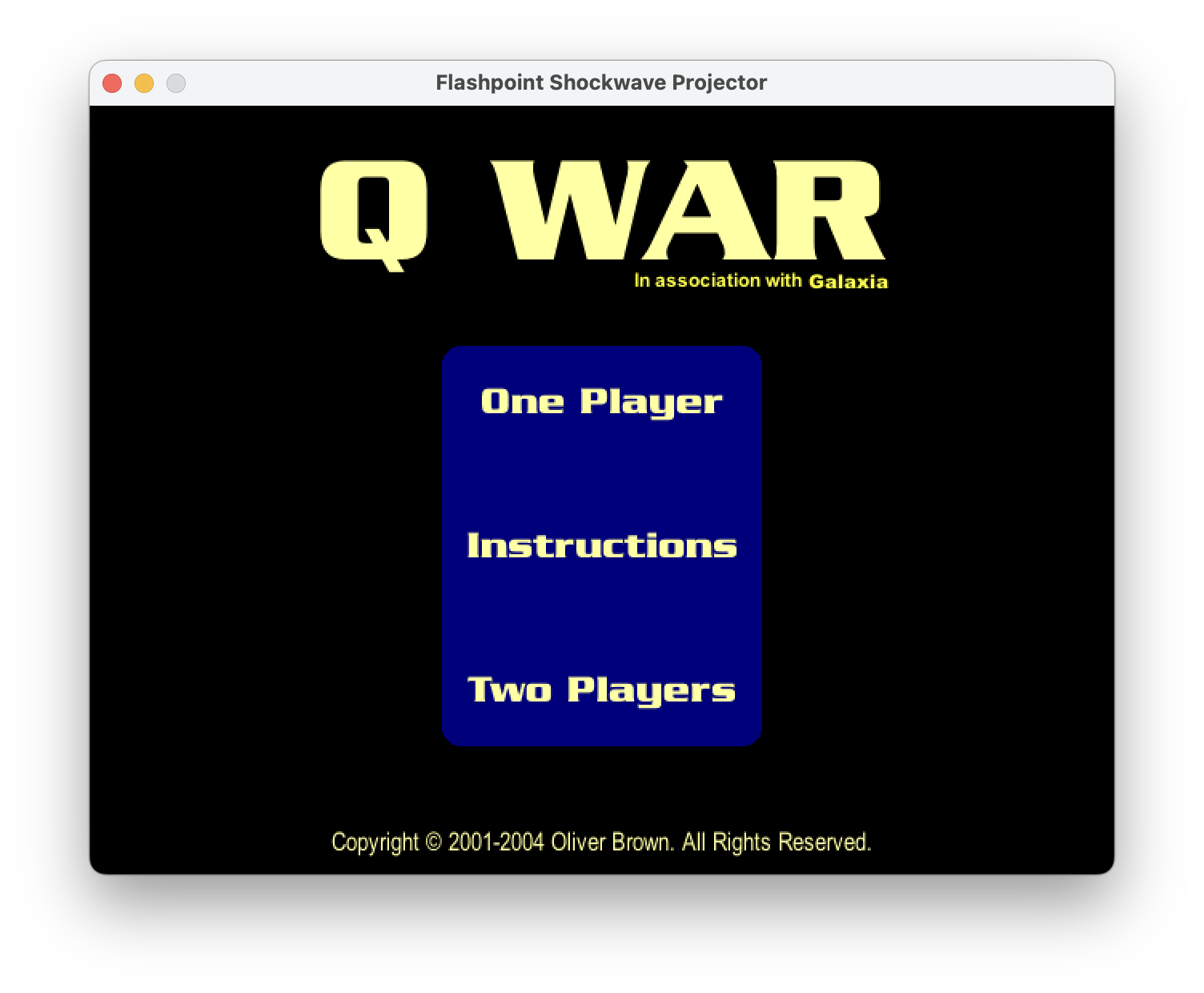
There are a few old posts on this blog mentioning Q War. Notably, my 2004 references spell it “QWar” rather than “Q War”. This is obviously wrong since the title screen clearly renders it as two words, but apparently past me was less bothered about such consistency.

Graphics

Unlike Supremacy, the graphics are “original”. And by original, I mean I didn’t just get them from the Lingo book and conceived of them myself. In reality they are lovingly based on existing Star Trek material.

Player ships

Player 1
Player 2

The player ship is the Bajoran Raider from Star Trek: Deep Space Nine. Weirdly, the original has a pair of struts connecting to the wings, but I’ve filled in the gap in the middle essentially making the wings wider.

I also added a tint to the ship which is blue and green for player one, and red and yellow for player two.

I would later reuse the ship graphic for Gravitas.

Enemy ships

Working this out took some time.

As a small aside I would like to call attention to the excellent Star Trek website Ex Astris Scientia by Bernard Schneider. In this case his Starship Gallery was an invaluable resource without which I would not have found the source of this ship.

The enemy ships are Vidiian ships, specifically the “Vidiian ship 3” from that link.

Possibly to introduce a bit more colour to the game, or maybe just to hide the source, I drastically changed the colour from the original brick red to the weird lilac cyan combo.

Enemy station

The space station is the Renegade Borg Ship from the Star Trek: The Next Generation episode Descent (the one with Lore and Hugh).

The only change I made was to make it green.

And honestly, I’ve always thought this shape makes much more sense as a station than a ship.

Asteroids

The asteroids actually are completely original creations I made in Paint Shop Pro 5, and for whatever reason I remember exactly how I made them.

  • Generate some random noise.
  • Apply Gaussian blur.
  • “Cut out” an asteroid outline.
  • Apply a circular gradient to add shadow.
  • Colourise.

Fonts

The main title and menu font is Trek Generation 1, which continues my theme of using Star Trek fonts in Shockwave games.

In this specific case, it was a surprise to me. For as long as I can remember I thought I’d used Copperplate Goth Bold (which does look similar) but when I actually explored the original source, I was wrong.

The longer text is Abadi MT Condensed Light.

Galaxia branding

Like Supremacy, some time after the initial release, I added the message “Brought to you by Galaxia”. Galaxia being another game I developed.

The future

Once DirPlayer has better support for my games, one of my goals is to recreate the Shocklive! site complete with both Supremacy and Q War. This would include a new, safer high score system to replace the original.

Screenshots
Supremacy added to Flashpoint

Oliver Brown
— This upcoming video may not be available to view yet.

Back in January I wrote about Flashpoint Archive and my intention to get my old Shockwave and Silverlight games added to it.

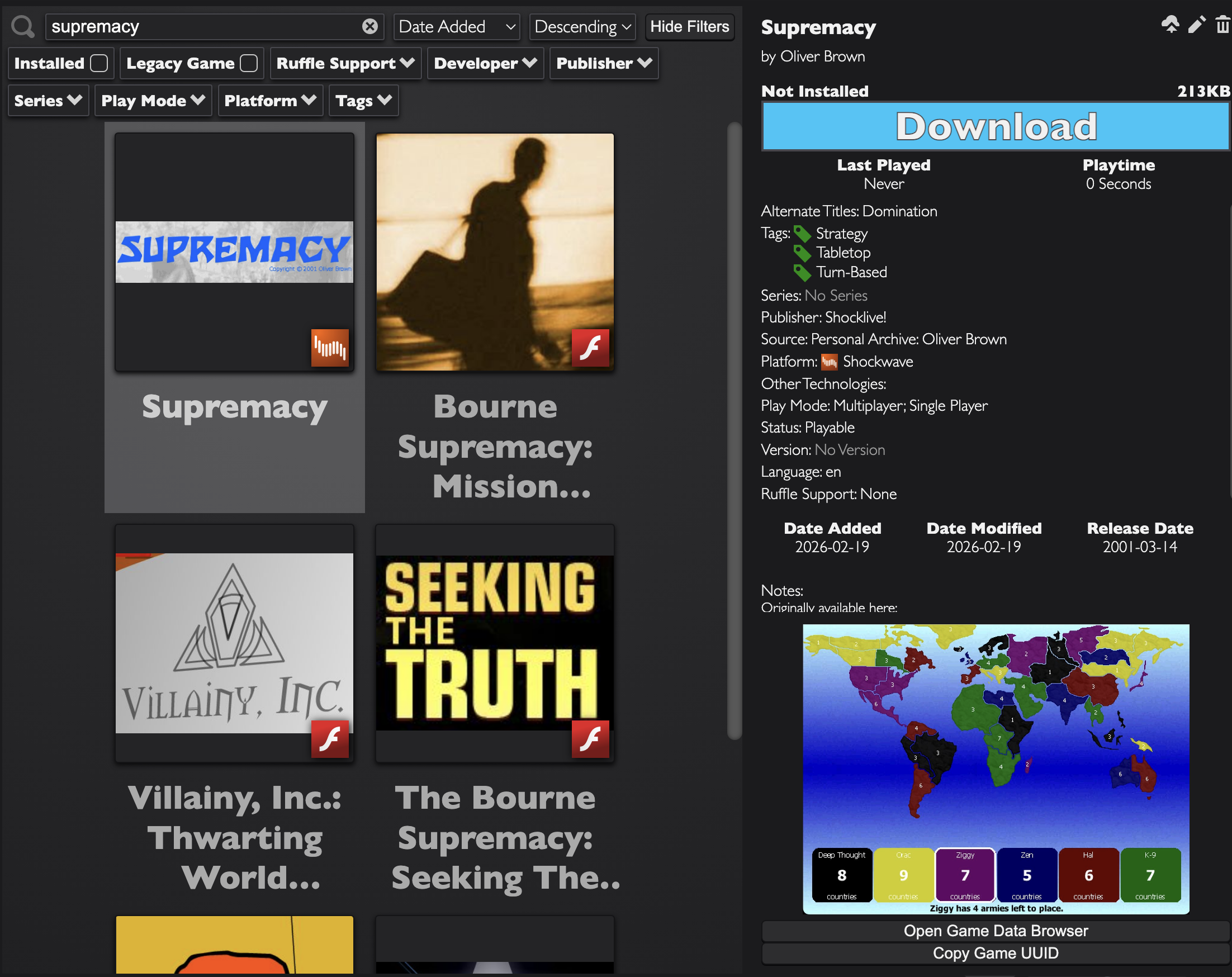
Supremacy has now been added to Flashpoint.

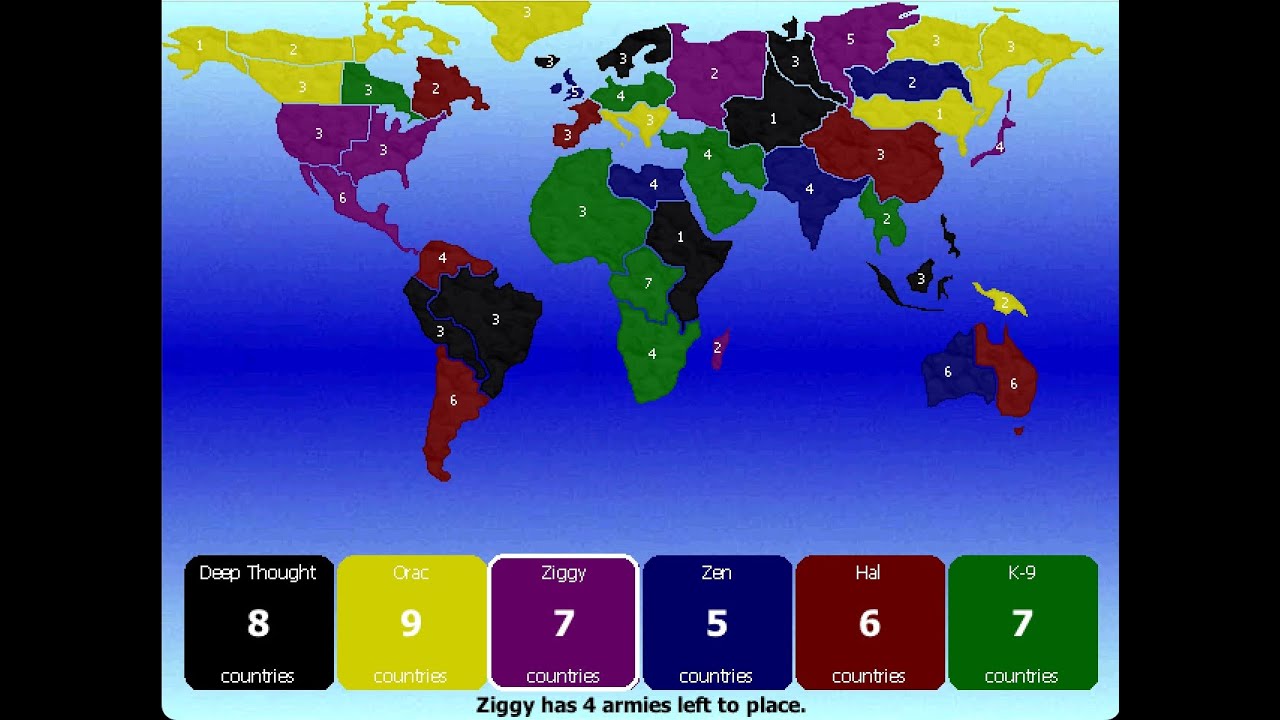
Supremacy is a Risk-style turn-based strategy game I wrote in Macromedia Director and originally released in 2001. It supports both single player (against AI opponents) and local multiplayer.

You can find it in Flashpoint under the name “Supremacy”.

If you have Flashpoint installed, give it a try.

Supremacy - Shockwave game

Oliver Brown
— This upcoming video may not be available to view yet.

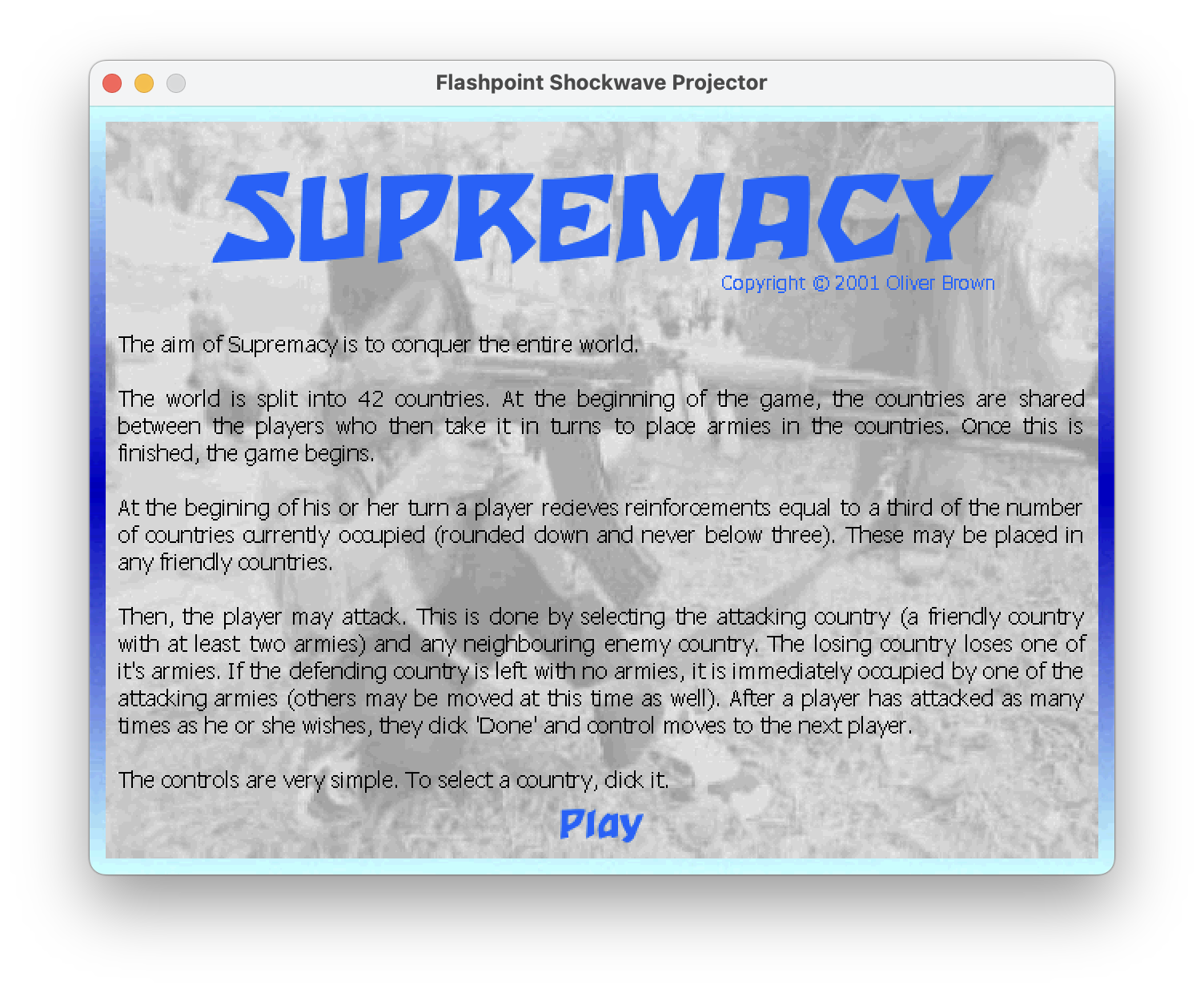
I started programming from a young age. One of the earliest programming projects I worked on that I was pleased with was a version of Risk called “Supremacy”.

Interacting with this video is done so under the Terms of Service of YouTube
View this video directly on YouTube

Shockwave was a technology created by Macromedia as a sort of companion/competitor/successor to the then ubiquitous Flash1.

Back in late 2000, I managed to get access to Macromedia Director1, the authoring software, and started playing around with it.

This was back when I was learning much of my programming from books (there was less available on the internet then). So I bought “Advanced Lingo for Games” by Gary Rosenzweig (Lingo being a bespoke programming language created just for Director).

Both Director and Advanced Lingo for Games are available on the Internet Archive now.

Supremacy is heavily based on the “Strategy Game” code sample included with that book. So much so, that the “Copyright © 2001 Oliver Brown” with no attribution makes me cringe a little now. So now is as good a time as any to thank Gary Rosenzweig for writing the book (and the code). I did eventually take it further, but that is for another post.

I made the game available on a website called “Shocklive!” on March 14, 2001 (and apparently released an update on March 18 with “no known bugs and better AI”).

Shocklive! as of May 17, 2001.

Today, the game has been submitted to the Flashpoint Archive and should be available soon.

Random trivia

Since it has been almost 25 years since I worked on the game, my memory has gaps. But I do still have the source code, so here are some things I can either remember or have worked out.

The name

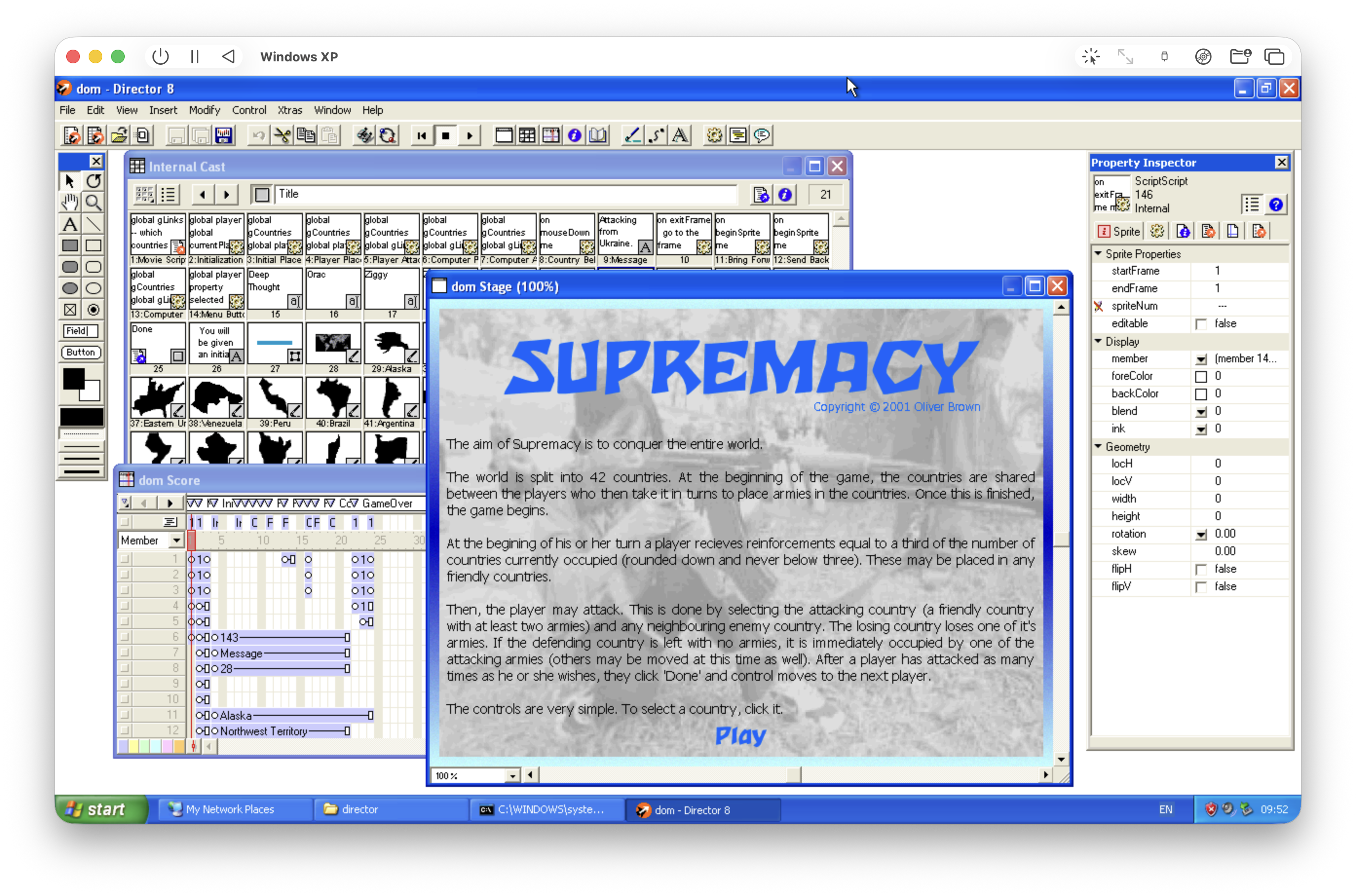
Early in development I called it “Domination”, which is why the main file for the game is called dom.dcr.

Risk mechanics

It really is a bare bones version of Risk (mostly because it was designed as a programming tutorial and at best as a jumping off point to do more).

It has the original 42 countries from Risk, and uses the base rule: reinforcements equal to a third of your country count. It does not have continent bonuses however. This makes it much harder to snowball and as a result games tend to take longer (see the video).

It also does not use dice - every battle just gives attackers and defenders an even chance to win. This, combined with the fact that it also has no cards further lengthens games.

The computer player names

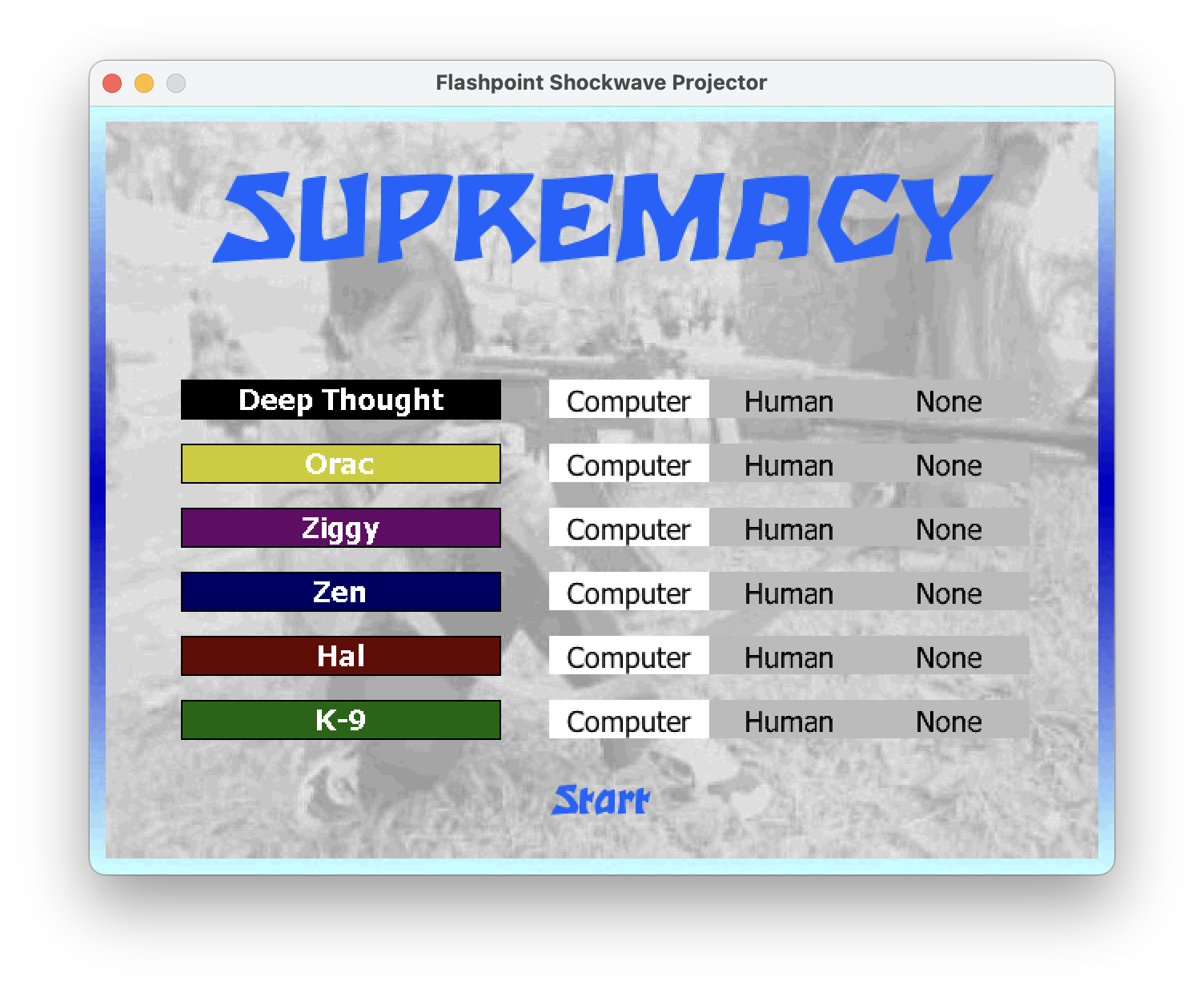
The default computer players are named after famous fictional AIs:

  • Deep Thought - The super computer from the Hitchhiker’s Guide to the Galaxy that determined the Answer to The Ultimate Question of Life, the Universe, and Everything was 42, and which went on to design an even more powerful computer, the Earth.
  • Orac - A sophisticated artificial intelligence from the British sci-fi TV series Blake’s 7.
  • Ziggy - The super hybrid computer from the sci-fi TV show Quantum Leap that runs Project Quantum Leap.
  • Zen - The master control computer of the Liberator, also from Blake’s 7.
  • Hal - The artificial intelligence and main antagonist in 2001: A Space Odyssey.
  • K-9 - The robot dog that was a companion in Doctor Who.

Title background

The background image is a Vietnamese girl holding an AK-47. I believe I sourced it from somewhere implying the girl was undergoing training to be part of some militia or military.

I still have the original copy and when I did a reverse image search I found it, with the description:

a Vietnamese high school girl practises taking aim with an AK-47 assault rifle during military training for students in Hanoi September 8 2000 high school and university students in communist ruled Vietnam take part in such training every year as part of a national defence programme"

Fonts

The main title font is Romulan Eagle. It sounds Star Trek based (which definitely makes sense with my interests at the time) but I honestly cannot remember anything about it. I have no idea where I found it. Possibly from the internet, possibly from a CD (CDs full of fonts were popular then).

The body font is Tahoma a standard Microsoft font which was apparently the standard screen font for Windows XP.

Also included in the project for some reason is Monaco, a font by Apple that was standard on Macs at the time. Which is a bit odd since I was using Windows at home and Acorn Computers at school.

Galaxia branding

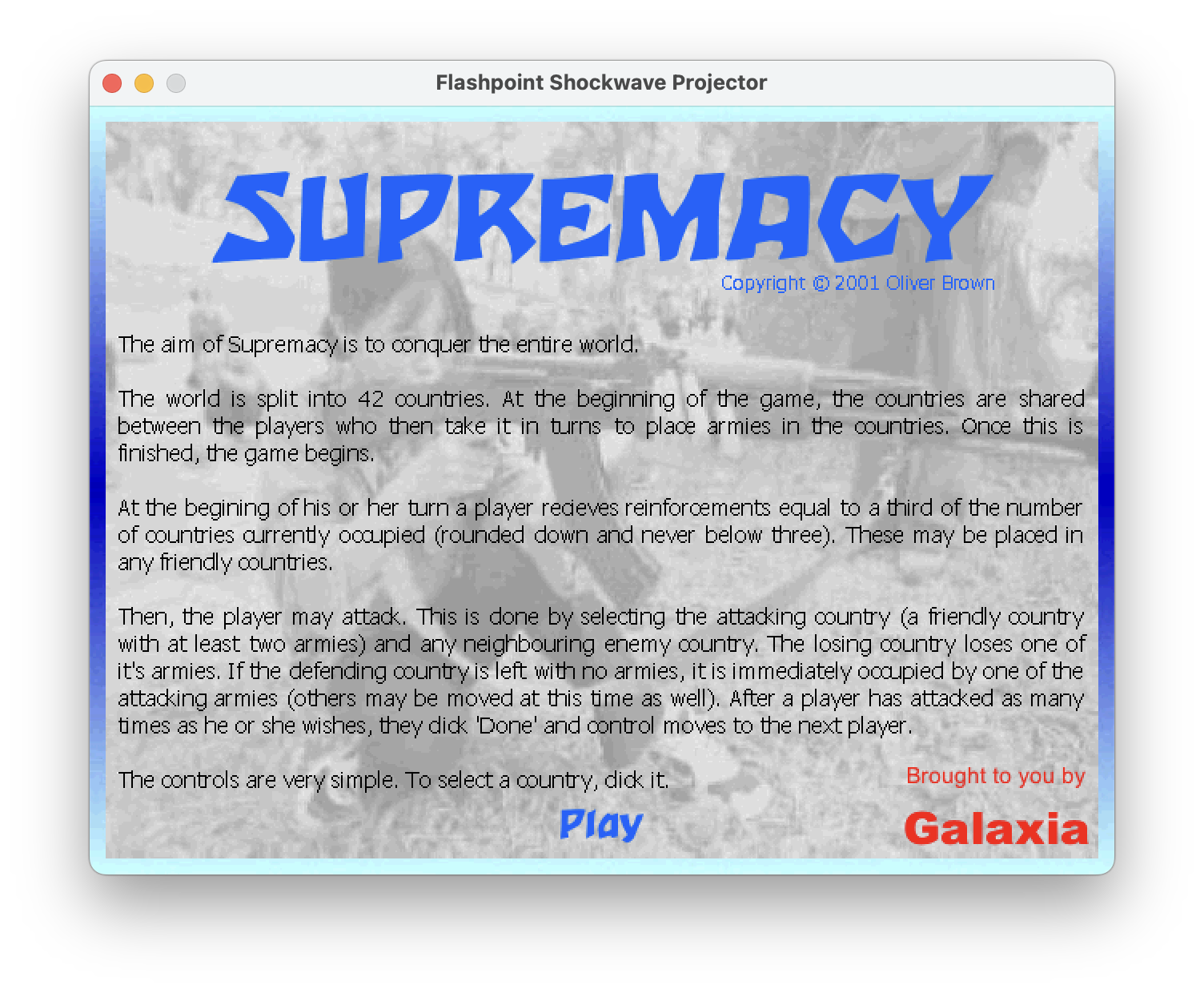
Some time after the initial release, I added the message “Brought to you by Galaxia”. Galaxia is another game I developed (from which I got the online name I’ve been using ever since - GalaxiaGuy). I was working on a new version of Galaxia (which I tried a few times) when I first started this blog. The old Galaxia posts are still available.

Life on this blog

In fact, the game was available for a while directly on this blog. Sadly, this is no longer the case.

Screenshots

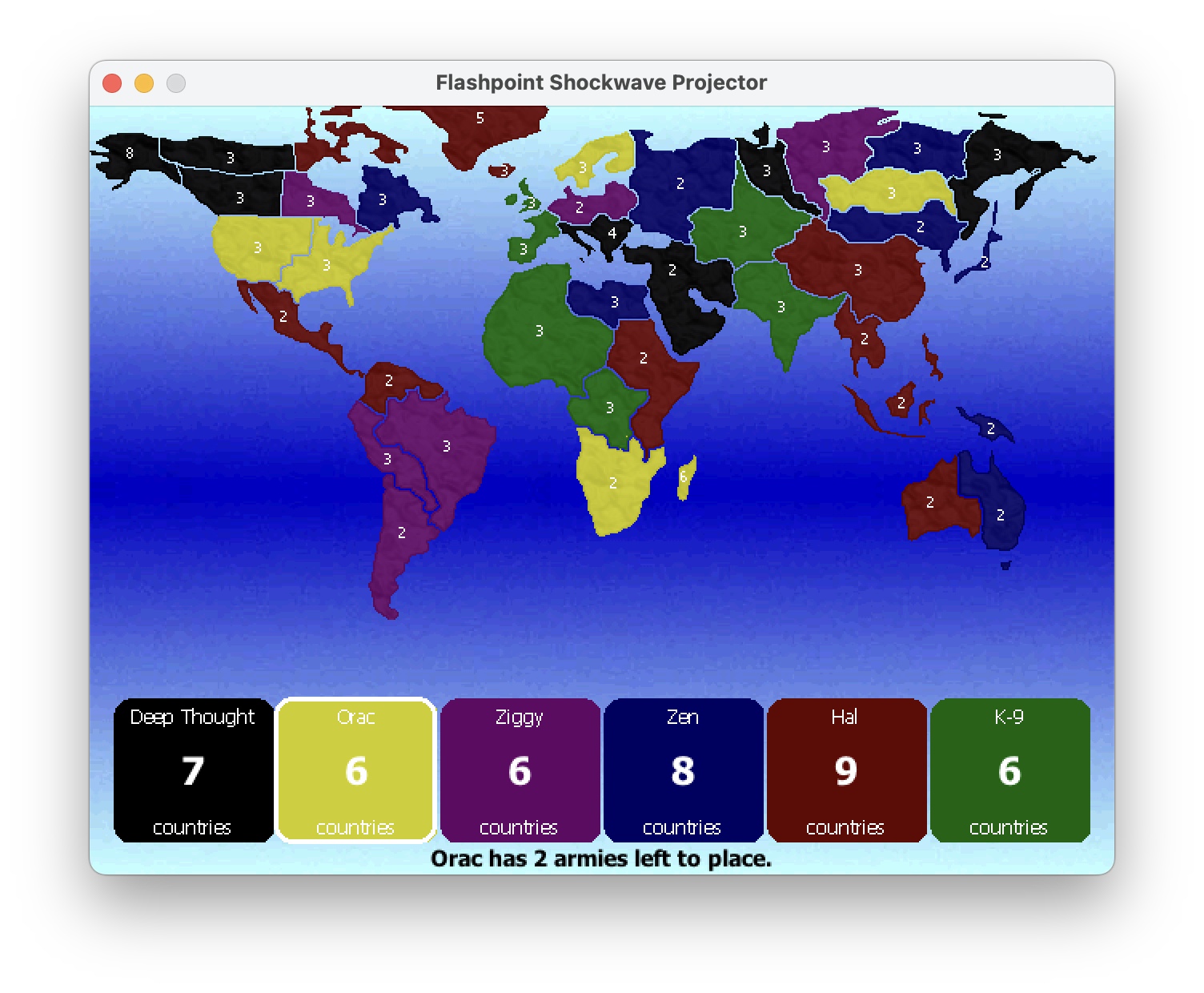
Some in game screenshots:

Opening in the project in Macromedia Director on a Windows XP VM:


  1. All the links say “Adobe”. It was Macromedia at the time. It shall live forever in my heart as “Macromedia”. ↩︎ ↩︎

Flashpoint Archive

Oliver Brown
— This upcoming video may not be available to view yet.

I’ve just found out about Flashpoint Archive, an application for playing old content created using Flash, as well as other obsolete browser technologies.

Interacting with this video is done so under the Terms of Service of YouTube
View this video directly on YouTube

The core functionality is provided by sandboxed versions of the plugins that run the content, a proxy server for games that need to believe they are run over the internet, and a launcher allowing you to browse and launch content - all wrapped up in a neat package.

And for the true archivists, there is a version that embeds all the content for download that, at the time of writing, is 2.28TB.

I’m interested in this for a couple of reasons.

Firstly, the preservation of history. I would like everything we create as a culture to remain available in some way (which is why I also support the Wayback Machine and the Internet Archive). I’m also of the right age that much of this was some of the most popular content available on the internet when I started using it.

But also, I myself have some stuff I’ve produced that is hard to access in modern browsers. Specifically, some Shockwave and Silverlight games.

So, for the near future I’m going to do what I can to get my games added to the archive.

Overcooked - Fun Coop Multiplayer Action

Oliver Brown
— This upcoming video may not be available to view yet.

I recently a recorded a bunch of videos of the game Overcooked on Xbox One.

Interacting with this video is done so under the Terms of Service of YouTube
View this video directly on YouTube

Your goal is to assemble meals out of various ingredients, cook them, and serve them. Over time the meals get a bit more complicated and the levels get a lot more complicated. It is strongly designed to be played cooperatively with up to four people, and even supports two players on a single controller.

My only complaint would be the difficulty is based too much on complicated level design (and jumps up a bit too quickly). Some times the controls are not exactly tight and you can end up selecting the wrong thing - having levels with moving targets or slippery floors for instance just accentuates an otherwise minor problem. I would have preferred more meal variations (that are also more complicated) on simpler levels.

But despite all that it’s a fun party game that almost anyone can play. And of course it is made in Unity.

One final note. The first video in the playlist above was generated by Google Photos. It turned out well, except for its automatic cropping.

Gravitas approaching playability

Oliver Brown
— This upcoming video may not be available to view yet.
Interacting with this video is done so under the Terms of Service of YouTube
View this video directly on YouTube

Gravitas is rapidly approaching something playable, now that ships can be destroyed and new levels are generated.

“Something playable” is still quite far away from being an actual game. In terms of features required for even an alpha release, it still needs: scoring, match state, player lobby, AI, and better level generation.

Some other features I would rather have but aren’t strictly required include: special powers (especially warping, to get players out of impossible situations), better UI feedback for touch controls (which was not necessary for the original) and some match options.

But overall, progress is good.

Unity Cloud Build

Oliver Brown
— This upcoming video may not be available to view yet.

[youtube https://www.youtube.com/watch?v=hPhbri7XIdo&w=640&h=360]

First, a video of the latest progress. Now includes aim lines.

Second, if you aren’t using Unity Cloud Build, you should be.

Over the past few years, the importance of automated builds in software development (and the wider concept of continuous integration) has grown in importance. In my day job, setting up automated builds is one of the first thing that happens on any project. The details tend to be different for different platforms and it generally requires a fair amount of maintenance. The good news is, Unity do most of the hard work for you, and across most of their platforms, and surprisingly, for free.

Technical Spikes vs MVP

Oliver Brown
— This upcoming video may not be available to view yet.
Interacting with this video is done so under the Terms of Service of YouTube
View this video directly on YouTube

In software development (and product development in general) is a concept called MVP or Minimal Viable Product. According to Wikipedia it is “a product with just enough features to gather validated learning about the product and its continued development”.

My plan was to develop a Gravitas MVP in Unity and release it as quickly as possible. After reading a bit about some of the cool things I can do with Unity quite easily that would have been hard before, I inevitably got distracted. But it’s okay, since technical spikes are also an accepted part of software development (again thanks to Wikipedia: “a product-testing method that is used to determine how much work will be required to solve or work around a software issue”).

Specifically, one of the things I wanted to do in Gravitas was add a real lighting model, probably using normal mapping on the sprites. I had read up how to do this in MonoGame, but decided to see how quickly I could do it in Unity. The answer was about 2 hours. That includes the time to create the normal map for the ship (and finding a tool to help do that).

The tool I used incidentally is Sprite Illuminator from a company called CodeAndWeb. If you plan to do any 2D games I suggest you check them out. Their tools all come with trials, and the only reason I haven’t bought it is yet, is I’m deciding which bundle to get (I’ve already used Sprite Illuminator and I’ll almost certainly use Texture Packer. Physics Editor is probably less useful to me, but is only £10 extra with the other two).

How to start "Hearts of Darkness" quest middle step "Stop Tanval" (Elder Scrolls Online)

Oliver Brown
— This upcoming video may not be available to view yet.

TLDR: Go to Kragenmoor to the Grandmsters Palace and find Grandmaster Omin Dres to begin the quest Aggressive Negotiations.

Elder Scrolls Online on consoles has an achievement/trophy called Hero of Ebonheart which requires you to complete all the in game achievements relating to the Ebonheart Pact.

As I was checking through the list of ones I completed, I noticed that for the achievement Hearts of Darkness, the middle step - Stop Tanval from unleashing the second Brother of Strife - was incomplete. When I checked the map there were no black markers normally indicative of an incomplete area, nor did I have any incomplete quests in Stonefalls.

It turns out there is short series of side quests that are easy to miss in the Kragenmoor area starting with Aggressive Negotiations. This eventually leads to To the Tormented Spire which adds the Tormented Spire as a location to your map. Complete this quest line completes the middle part of the Hearts of Darkness achievement.